Dealers
 Sales portal
What are vertical tillage tools?
Vertical tillage tools are coulter-based implements that size residue and open the top few inches of soil without turning it over. They keep most residue near the surface.
Why it matters on the Prairies

Heavy crop residues from canola, corn or a big cereal crop can form a mat in spring. That mat slows soil warming and plugs seeder openers. Fall is one window: after a heavy canola or corn crop, or to level harvest ruts before freeze-up.
How producers handle it
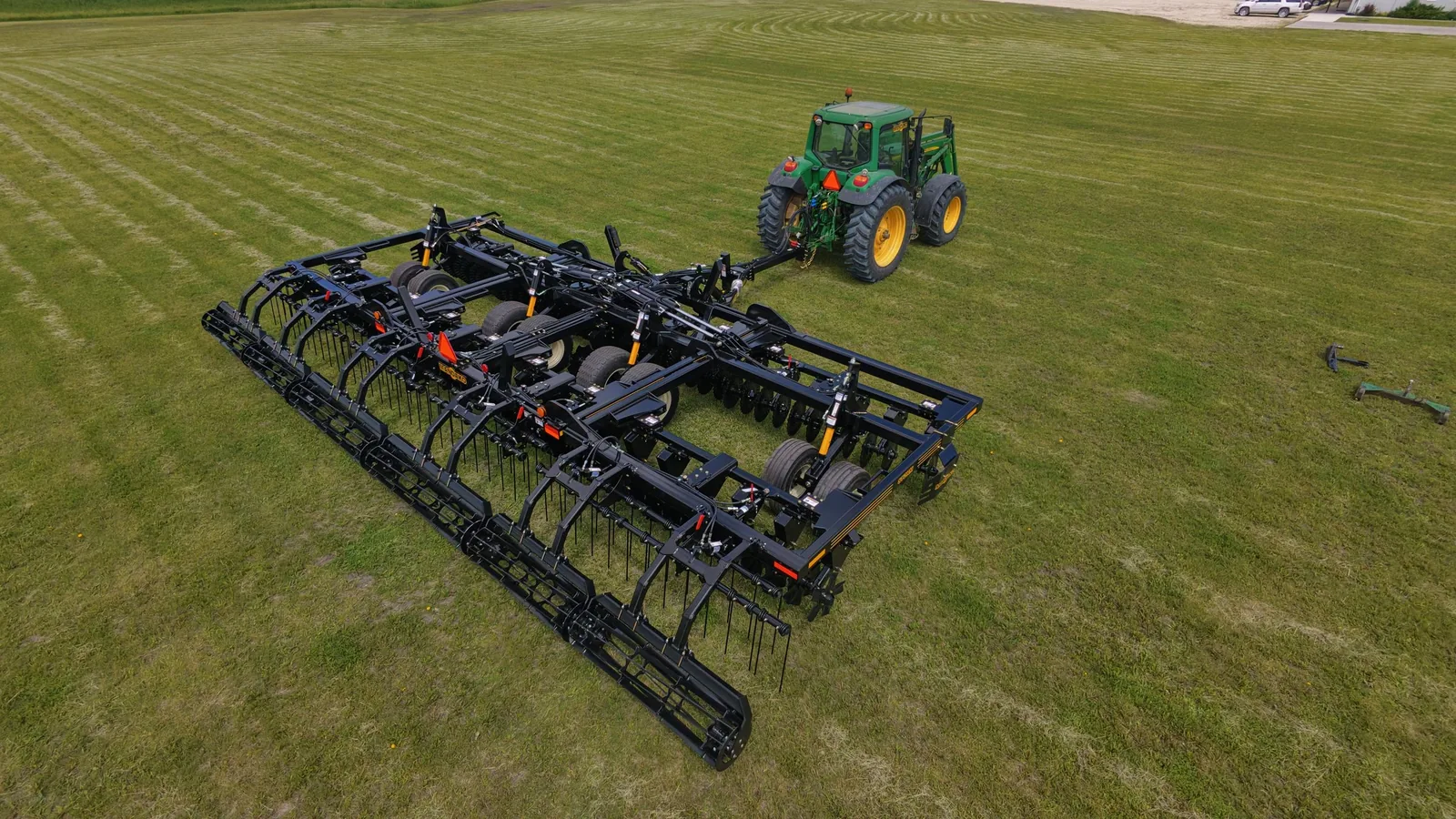
Spring, before seeding, is the other window. On a coulter tool like this, the toolbar angle sets the job. At 0° the 20-inch coulters slice straight through and leave the surface close to how they found it, which suits a wet spring when the ground needs to dry and warm without smearing. Opened up toward 14°, the blades move soil, mix residue and level ruts. Blade depth runs from 1 to 6 inches.
Know the limits. Working wet soil causes soil compaction and clods that hurt seeding depth. Manitoba Agriculture says one tillage pass dries the soil by about 0.5 inch (12.7 mm) of water. A shallow tool works only the top few inches, so it does not replace deep ripping or subsoiling.
Do not expect a yield bump either. A Saskatchewan flax-stubble study found wheat, pea and canola yields after vertical tillage were not significantly different from other residue treatments. Good straw chopping and spreading at the combine comes first.
Equipment that fits
For big acres, start with the Mandako STORM, a hydraulic-angle vertical tillage tool built in Plum Coulee for 405 hp and up. The angle adjusts from 0° to 14° from the cab, so you can set it by field conditions: flat in a wet spring, opened up after a heavy crop. If you need to get down narrow roads, the Mandako Euro STORM is a 2-section version made for narrow roads and stricter transport rules.